Engineers have specified steel rebar in reinforced concrete for more than a century. Contractors know how to place it, engineers know how to design around it, and crews bend, cut, tie and splice it with familiar tools. In dry, protected and conventional structures, steel remains a proven reinforcement material.
Fiberglass rebar, also called GFRP rebar, FRP rebar or GRP rebar, solves a different problem: corrosion. When concrete sees seawater, chlorides, wet soil, wastewater or industrial chemicals, steel reinforcement rusts, expands, cracks the concrete and causes spalling. GFRP contains no steel, so it does not rust like carbon steel reinforcement.
For construction, infrastructure, marine, industrial and tunnelling projects in Pakistan, Fibre Craft Industries (FCI Composites) manufactures FRP/GRP rebars and rock bolts in multiple sizes and grades. The right choice between steel and GFRP depends on corrosion risk, stiffness, ductility, detailing, handling, fire exposure and code requirements.
For the core reinforcement page, see FCI FRP/GRP rebars and rock bolts. For adjacent corrosion-resistant systems, FCI also supplies FRP tanks, fiberglass pipe and structural profiles.
GFRP stands for glass fiber reinforced polymer. Manufacturers align continuous glass fibers along the length of the reinforcement and bind them inside a polymer resin matrix. The fibers carry tensile load, while the resin protects and holds the fibers together.
The bar surface matters. Steel rebar uses ribs to bond with concrete. GFRP rebar uses a textured, sand-coated, helically wrapped or deformed surface, depending on the manufacturer. A smooth fiberglass rod is not structural reinforcing bar; the surface profile transfers tension between concrete and reinforcement.
FRP and GRP are broader terms. FRP means fiber reinforced polymer. GRP means glass reinforced plastic or glass reinforced polymer. GFRP is the glass-fiber version commonly used for concrete reinforcement.
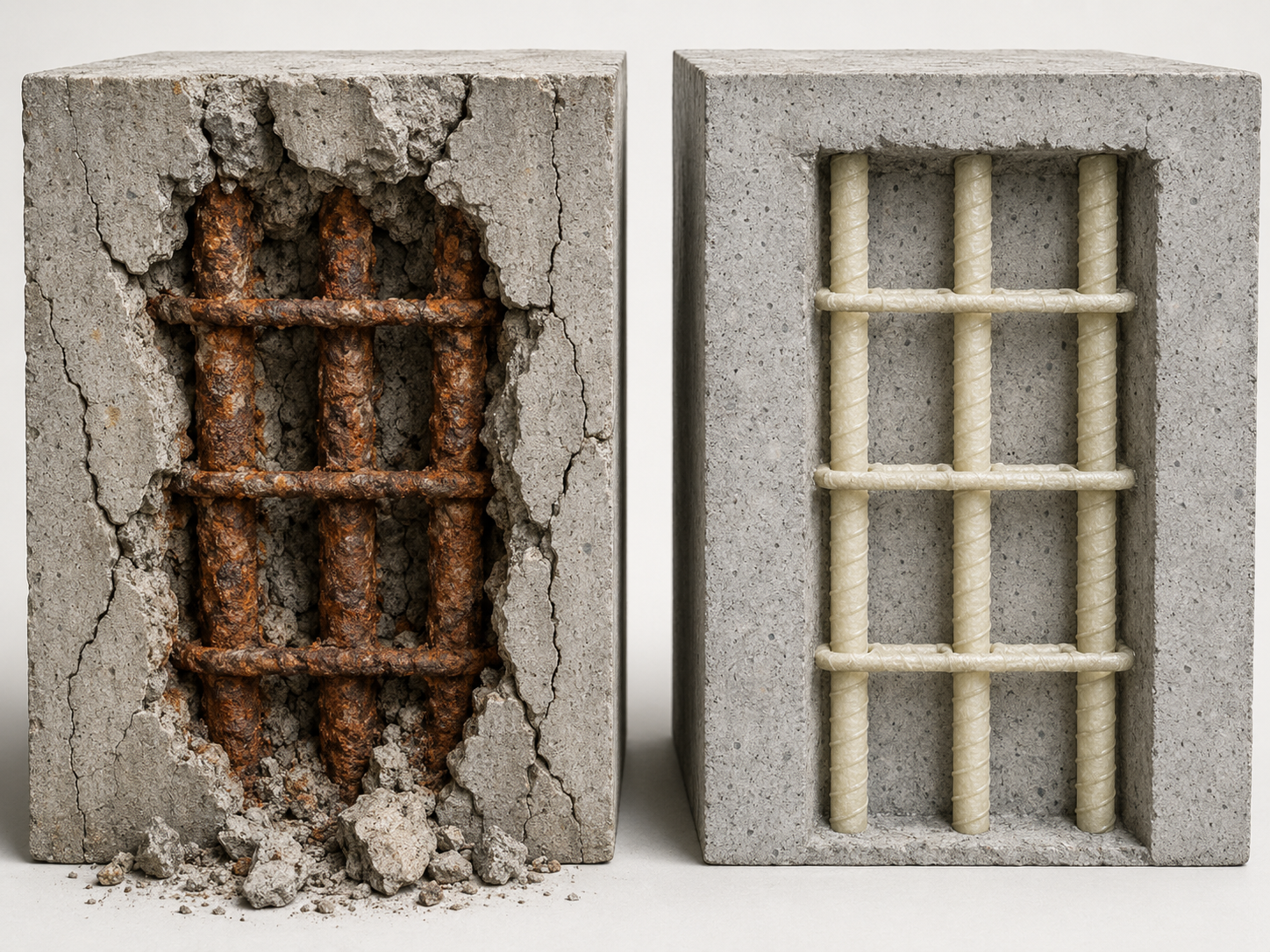
Rebar corrosion rarely stays small. A rust stain becomes a crack. A crack admits more moisture and oxygen. Steel expands as it corrodes, concrete spalls, and the owner pays for breaking out concrete, repairing reinforcement and patching the section.
That repair cycle matters in seawalls, jetties, wastewater structures, wet industrial floors, chemical containment areas, bridge decks, parking structures and foundations in aggressive soils.
GFRP rebar removes the steel rust mechanism. It still needs correct concrete cover, proper placement and suitable design, but it gives the structure a major durability advantage when corrosion is the main threat.

GFRP rebar exceeds conventional steel in ultimate tensile strength in many grades. Engineers still need to check stiffness, ductility, crack width, deflection, anchorage and serviceability before replacing steel with GFRP.
FCI describes its FRP/GRP rebar as offering high tensile performance at low weight, with up to 8 times the performance-to-weight ratio of steel.
Tensile strength alone does not determine suitability. Steel's higher modulus means less stretch under load. GFRP's lower modulus requires engineers to check crack width, deflection and serviceability.
Steel yields before failure, which gives warning and allows redistribution in many reinforced concrete designs. GFRP behaves elastically until failure, so engineers need GFRP-specific safety factors, strain limits, development lengths and serviceability checks.
GFRP is lighter too. Crews move bundles, cages and longer bar lengths with less lifting strain, and transport and staging become easier. Workers still need gloves, eye protection, respiratory protection and dust control when cutting or handling the bars.
Switching from steel to GFRP after drawings are complete requires structural engineer review.
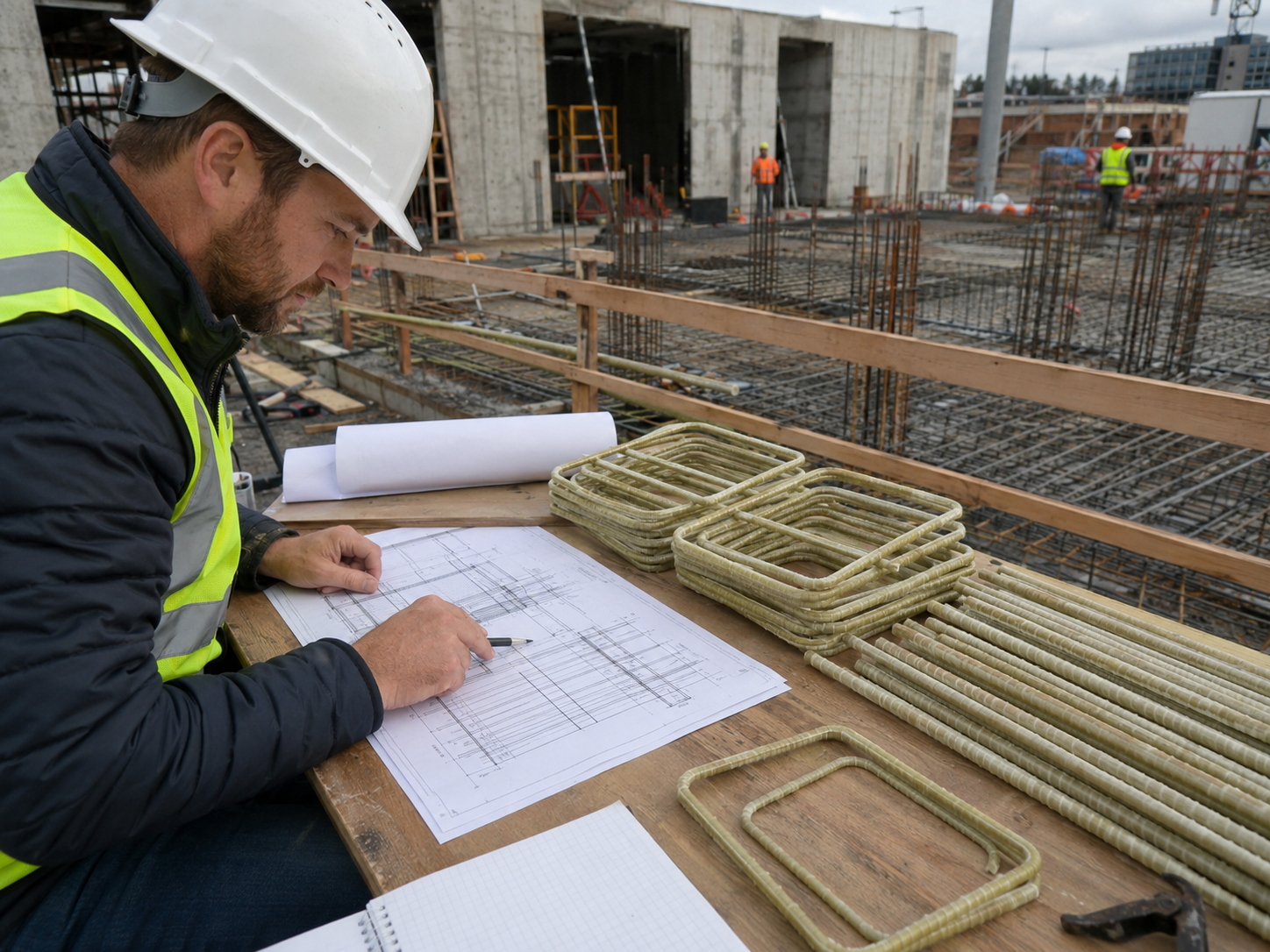
Steel gives contractors field flexibility. If a site condition changes, crews bend a bar, adjust a hook or work around an obstruction.
GFRP cannot be bent on site. Workers can cut it after curing, but bent bars, stirrups, hooks and special shapes need to be planned and fabricated before delivery.
Select GFRP early. The engineer, contractor and supplier need to coordinate bar schedules, shop drawings, bend shapes, lap splices, development lengths and placement details before the material reaches the site.
Steel still makes better sense in many projects. Choose steel when the design depends on high ductility, field bending, high shear dowel action, established seismic detailing, fire-rating familiarity or the lowest upfront material cost in low-corrosion environments.
Steel is also practical when the site expects many field changes. If crews need to bend bars around unexpected obstructions or make adjustments after formwork changes, steel gives more flexibility.
Many projects use both materials. Keep steel in connections, dowels or high-ductility details, and use GFRP in corrosion-exposed slabs, walls or foundations. Mixed reinforcement needs clear drawings, bar marks and site supervision.
Before specifying GFRP rebar, confirm:
Treat GFRP as a distinct reinforcement material with its own design logic, not a lighter steel substitute.
Steel usually costs less upfront, especially in small conventional projects. GFRP has a higher unit price and requires earlier coordination.
Corrosion flips the cost calculation. When steel needs extra cover, coatings, stainless upgrades, frequent repairs or early replacement, GFRP wins on lifecycle cost. The lighter weight reduces handling effort, transport load and installation strain.
A dry indoor slab and a coastal wastewater structure do not have the same risk profile. The dry slab favors steel. The wastewater structure justifies GFRP because corrosion repairs can cost far more than the reinforcement premium.
Specify GFRP rebar when corrosion resistance, low weight or non-metallic behavior solves a structural or durability problem.
Common applications include:
Pakistan's coastal infrastructure, ports, chemical plants, water treatment facilities, tunnels and mining operations benefit from GFRP's corrosion resistance.
If the project also needs access or walkway components, grating and industrial staircase platforms fit the same corrosive environments.
GFRP rock bolts provide the same corrosion resistance for ground support.
Confirm bolt type, anchorage method, resin system, thread or head detail, load requirement and ground-condition compatibility.
Before requesting a quote, prepare:
FCI Composites supplies FRP/GRP rebars and rock bolts for construction, infrastructure, tunnelling and ground-support applications in Pakistan. Use the FCI FRP/GRP rebars and rock bolts page to start a quote request.
For broader project packages, FCI also supports FRP tanks, fiberglass pipe, grating and structural profiles.
For coastal, marine, chemical, wastewater, tunnelling and ground-support projects in Pakistan, FCI Composites can help project teams align bar size, grade, quantity, delivery schedule and custom shapes before procurement locks in a steel-only design.
Share your application, exposure condition, required diameters, quantities and bent-shape requirements with FCI Composites through the FRP/GRP rebars and rock bolts product page.
GFRP rebar exceeds conventional steel in ultimate tensile strength in many grades. Engineers still need to check stiffness, ductility, crack width, deflection, anchorage and serviceability before replacing steel with GFRP.
No. GFRP rebar contains no steel, so it does not rust like carbon steel reinforcement. Engineers use it for marine, coastal, chemical, wastewater and chloride-exposed concrete.
No. Workers can cut cured GFRP rebar on site, but they cannot bend it into new shapes. Bent bars, stirrups, hooks and special shapes must be fabricated before delivery.
Yes, in some foundation slabs, but only when the engineer designs the slab for GFRP properties. Bar size, spacing, laps, development length, serviceability and dowel details need review.
Common uses include marine structures, bridge decks, wastewater plants, chemical facilities, exterior slabs, retaining walls, corrosion-exposed foundations, concrete repairs, tunnels and mining ground support.
Share your application, exposure condition, required diameters, quantities, grades and custom-shape requirements with FCI Composites through the FRP/GRP rebars and rock bolts product page.