A cooling tower removes heat from recirculating water so chillers, condensers, process equipment and production lines can keep running. In Pakistan, that same tower also has to handle hot weather, dusty air, variable makeup water quality and long operating hours. Sizing, material selection and maintenance decide how well it performs after installation.
This guide explains how cooling towers work, the terms buyers hear during selection, the main tower types used in industrial projects, and the information an engineer needs before quoting a tower.
A cooling tower cools hot water by moving air across water and using evaporation to reject heat. The cooled water returns to the chiller, condenser or process loop. Good performance depends on the site wet bulb temperature, water flow rate, range, approach, airflow, fill media, water distribution, water treatment and regular cleaning.
For industrial sites in Pakistan, FRP cooling tower structures make sense where corrosion, moisture and chemical exposure damage steel or wooden components. FRP does not remove the need for water treatment. Scale, biological growth, blocked nozzles and poor blowdown control can still hurt performance.
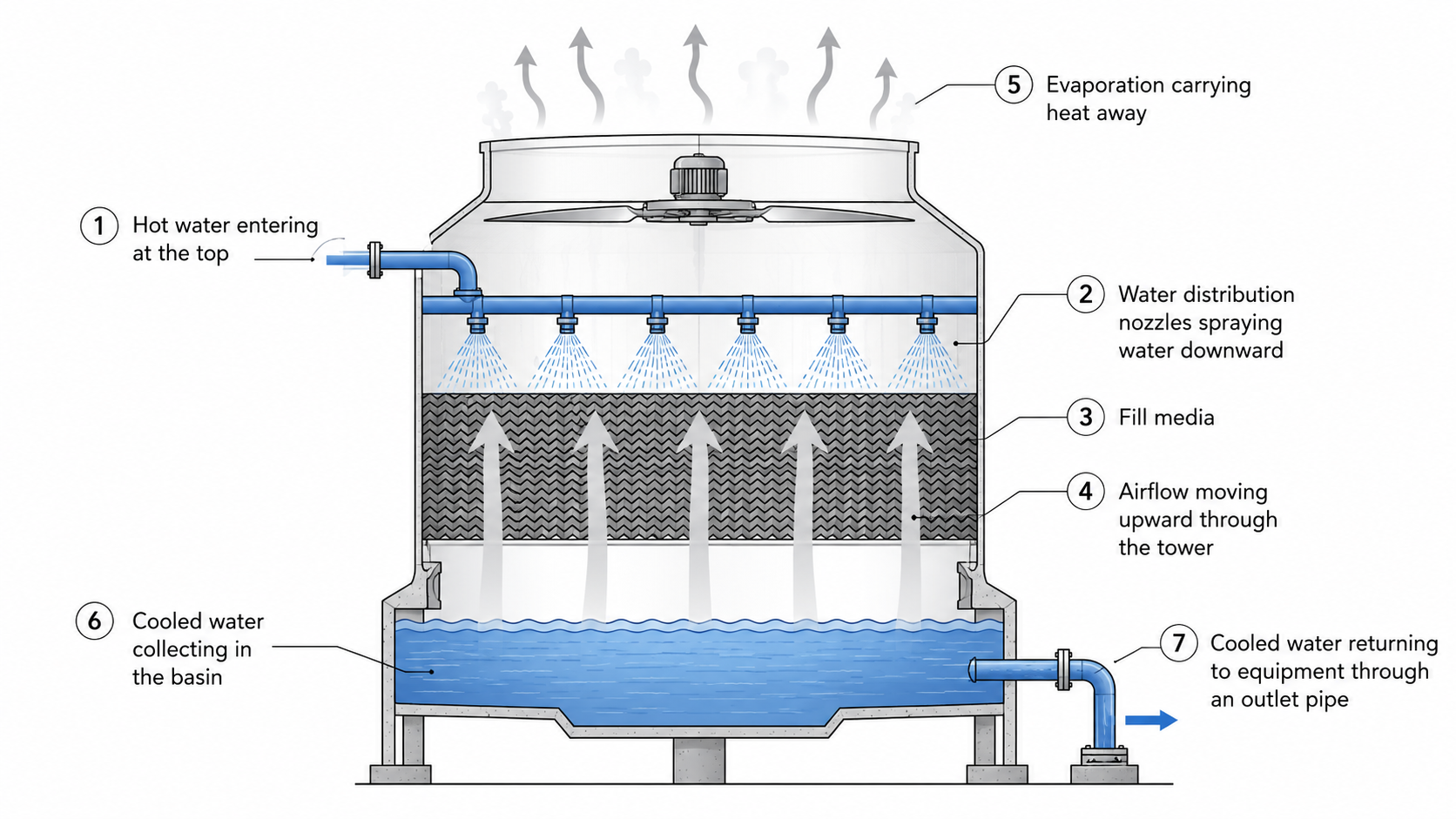
Hot water enters the tower from the process or HVAC system. Nozzles or distribution trays spread that water over fill media. A fan moves air through the tower. As air meets the falling water, part of the water evaporates. That evaporation carries heat away, and the remaining water drops into the cold-water basin at a lower temperature.
The cooled water then returns to the equipment. The tower does not create cold water out of nothing. It rejects heat to the atmosphere, and the entering air wet bulb temperature sets the practical limit.
Wet bulb temperature reflects air temperature and humidity together. Cooling towers are selected against wet bulb temperature, not dry bulb temperature alone. A tower in humid weather cannot cool water as close to the dry air temperature as it can in dry weather.
Range is the temperature drop across the tower.
Range = hot water temperature - cold water temperature
If water enters at 40°C and leaves at 32°C, the range is 8°C.
Approach is the difference between cold water leaving the tower and the entering air wet bulb temperature.
Approach = cold water temperature - wet bulb temperature
If cold water leaves at 32°C and the wet bulb temperature is 27°C, the approach is 5°C. A lower approach needs a larger tower, more effective fill, stronger airflow, cleaner water distribution or a combination of these.
Plant teams use this field formula for a quick performance check:
Efficiency = range / (range + approach) x 100
With an 8°C range and a 5°C approach, the result is about 61.5 percent. Treat this as a practical indicator, not a certificate of thermal performance. Final selection should use project data, site wet bulb temperature and the tower manufacturer's engineering calculation.
In an open circuit tower, process or condenser water meets air inside the tower. This is common for HVAC systems, industrial process cooling and many plant utilities. Open towers can work well, but the circulating water needs treatment because it picks up dust, oxygen and dissolved solids.
In a crossflow tower, water falls downward while air moves across it from the side. Crossflow designs give maintenance teams easier access to the fill and water distribution system during inspection and cleaning.
In a counterflow tower, water falls downward while air moves upward through the fill. Counterflow designs suit industrial sites where footprint is limited.
A closed loop, or closed circuit, tower keeps the process fluid inside a coil. Spray water and air remove heat from the outside of that coil. This protects the process circuit from outside air and contamination, which helps when pumps, heat exchangers, compressors, furnaces, generators or chillers need cleaner circulating fluid.
FCI has a separate product page for closed loop cooling towers with more detail on industrial applications.
Package cooling towers suit smaller and medium duties where the buyer needs faster installation and a compact footprint. Field erected cooling towers are built at site for high-capacity industrial projects where a standard package unit does not fit the cooling load, layout or structure requirement.
Most cooling tower problems come from a short list of causes: an undersized tower, weak fan airflow, fouled fill media, uneven water distribution, blocked drift eliminators, restricted air inlets or poor water chemistry.
On Pakistani industrial sites, engineers should pay close attention to:
A cooling tower loses water in three normal ways: evaporation, drift and blowdown. Leaks or basin overflow add extra loss and should be treated as faults.
As water evaporates, minerals stay behind in the circulating water. If the concentration rises too far, scale and corrosion can reduce heat transfer and damage equipment. Blowdown controls that concentration by draining part of the recirculating water and replacing it with fresh makeup water.
Cycles of concentration compare dissolved solids in the tower water with dissolved solids in the makeup water. Higher cycles can reduce makeup and blowdown water, but the water chemistry and treatment program set the limit. A water treatment specialist should set the safe operating range.
A cooling tower needs routine attention. Cleaning, testing and record-keeping protect performance.
Cooling towers can also create a health risk if water systems allow Legionella bacteria to grow and aerosolize. OSHA and CDC guidance both stress water management, cleaning, disinfection, scale control and maintenance records. For hospitals, malls, factories and large HVAC systems, a documented water management program is a serious operating requirement, not a paperwork exercise.
FRP means fiberglass reinforced plastic. In cooling towers, FRP pultruded members and molded components are used because they resist corrosion and moisture better than many metal alternatives. That matters in chemical plants, fertilizer plants, coastal locations, wastewater areas and wet industrial environments.
FRP can help with:
FRP still needs proper engineering. Resin selection, member size, connections, access platforms, fan loads, vibration and maintenance access all affect tower life.
A useful cooling tower quotation starts with data. Before asking a manufacturer for price, collect the following information:
Without these details, a quotation can look cheaper on paper and fail at site.
FCI Composites designs, manufactures and installs cooling towers in Pakistan for industrial and commercial projects. FCI's cooling tower range includes package type towers, factory assembled towers, closed loop evaporative coolers and field erected cooling towers. The company also manufactures FRP pultruded structures and cooling tower components for corrosive and demanding environments.
For product details, see FCI's cooling tower manufacturer in Pakistan page. For closed circuit systems, see closed loop cooling towers.
Recent cooling tower work includes a 2-cell FRP pultruded counterflow cooling tower at GH2 Industries and a cooling tower revamp at Fatima Fertilizer Sheikhupura involving pultruded FRP water distribution trays.
A cooling tower removes heat from recirculating water and sends cooler water back to a chiller, condenser, machine or industrial process. This reduces the need to discharge hot water after one pass.
Range measures the temperature drop across the tower. Approach measures how close the cold water temperature gets to the entering air wet bulb temperature.
A lower approach can improve cooling performance, but it needs more tower surface area, airflow, fill effectiveness or cost. The right approach depends on the process requirement and site conditions.
Blowdown controls dissolved solids in the circulating water. Poor blowdown control can cause scale, corrosion and loss of heat transfer. Too much blowdown wastes water and chemicals.
No. FRP helps with corrosion resistance, but scale depends on water chemistry, temperature, evaporation, cycles of concentration and treatment. Hard water still needs proper monitoring and control.
Consider a closed loop tower when the process fluid needs protection from air, dust and contamination, or when equipment life and cleaner circulation matter more than the lower first cost of an open tower.